

These days on the internet, everyone seems to want something from you: your time, your money, your input, your likes and subscribes.
As a result, you may have learned to be skeptical: “What do they want from me now? Can I really trust them?”
Here at TGL, we have a theory. Every single act of outbound communication, from an email reply to an Instagram reel, has the potential to build or break trust. If you’re the one responsible for creating that email or that Instagram reel, you’re starting out behind the 8-ball, even if your organization is doing genuinely incredible work.
(We're not the only ones who have come up with this theory, by the way; some people describe it as “trust as currency.”)
And the pressure is on: yes, your ideal audience should trust you, but so should your vendors, your peers, and your colleagues. Everyone who comes in contact with you or your organization should ideally leave that experience wishing they could leave a 5-star review.
No pressure, right?
TIME AFTER TIME
Trust is not built in a day. Multiple proof points are needed before someone is willing to take a real action that shows they trust you.
Think about it this way: did you trust your long-term partner the way you do now on your first date? We don’t think so; that rapport was built over time — for some people, over decades — and involved talking, listening, and learning about each other.
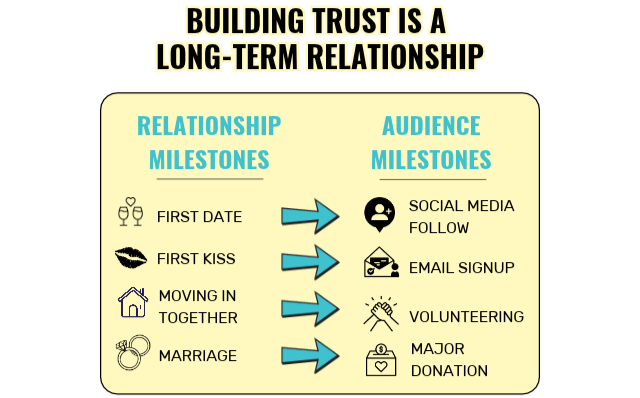
Of course, these examples aren’t exact, but the point is to build enough trust through little decisions so that when you ask people to do the big thing (donate, attend an event, volunteer, etc.), they’re already committed. They know you, and they believe that you mean what you say.
ACCURACY MATTERS
Remember the old “punctuation matters” example of “Let's eat Grandma!” vs “Let’s eat, Grandma!”? Every time your brand interacts with an audience, you’re choosing whether you’re going to eat Grandma or eat with Grandma.
(This is true, literally: if your website, social media posts, and collateral have typos, people are left wondering what else is done carelessly.
In the era of “fake news,” there has never been a more important time to confirm truth, verify correctness, and stand by facts.
But as a communications professional, it’s your job not only to ensure accuracy in facts and narrative, but also in your brand voice and authenticity. Keep colors, tone, cadence, and messaging consistent. Trust isn’t just the big thing: it’s the little things, too!
PEOPLE LIKE PEOPLE
Connection is essential to trust. When people understand your work — the meaning behind it, the importance of it, and the reality of it — it builds not only connection, but a solid reputation in the long run.
How can you integrate what matters about your work at every level of your communications? How does your why, your mission, and your impact shine through your visuals, word choice, and more? What part of it means the most to your audience?
We’re all communications professionals here. (And if not, hi, you’re welcome here, too!) So we all know that our jobs are ultimately always about connection. But when we’re answering the fifth “urgent” email of the day at 9AM, fighting tooth and nail for a semblance of a budget, or drowning from wearing multiple hats, it’s easy to forget that.
So this is your reminder! Don’t trade authenticity for efficiency. It only takes 2 extra seconds to ask, “How can I integrate a moment of humanity here?” and it will pay dividends.
THE MORAL OF THE STORY
Just like a romantic relationship, trust with your audience is built on the little things. Your interactions at conferences, your elevator pitch, your storytelling, your brand colors, and your grammar on social media.
All of these little proof points, over time, add up to the big things.
“Can I trust them with my donation?”
“Is this an organization I want to invest my time into?”
“Do they really make that much of an impact?”
Prove to them that the answer is always an enthusiastic yes.